

Hank is eleven now, a yellow Lab who weighs about seventy-eight pounds and used to meet me at the back door before I had the screen all the way open. These days he takes a second to get his feet under him after a nap, and on cold mornings he stands at the top of the three brick steps and thinks about it before he goes down. Our vet said it is age-related stiffness in his hips and that he is carrying a little extra weight, and suggested keeping him lean and talking about a joint supplement. That was the whole conversation. No promises, no prescriptions.
Daisy is the other one, a beagle mix we adopted from the Smith County shelter in 2019, eight years old and still bouncy but picky as all get out. She spits out tablets. She once ate around a pill hidden in a slice of cheese and left the pill on the floor like a jury's verdict. When our vet suggested a green lipped mussel chew for her, we ended up with Zesty Paws Mussel Mobility Bites, and I had two questions before anything else: what does the label actually say, and how do I work this into a day that already has a rhythm to it? That is what this page is. Five steps, in order, the way I did it in our house.
The chew Daisy actually finishes, every single morning
Zesty Paws Mussel Mobility Bites are the soft chews we landed on for Daisy. Green lipped mussel, chicken and mussel flavor, and a label you can read without a decoder ring.
Amazon See the label and today's price on Amazon →Before step one, one thing that outranks every word below. Call your vet. Not because green lipped mussel is dangerous, but because your dog is not my dog, and a dog on other medication, a dog with a sensitive stomach, a dog who has just had surgery, all of those are conversations for a person who has actually examined your animal. Our vet is the one who suggested this for Daisy. I am not a vet, I have never been one, and nothing here should be read as though I am. This is a notebook, not a prescription.
Step 1: Ask the vet before you buy anything
I know that reads like the part people skip. Do not skip it. When our vet said to try a green lipped mussel chew for Daisy, I wrote it in the spiral notebook I keep taped inside the kitchen cabinet door, along with the date. January 2026. That notebook is the single most useful thing I own for this. It has Hank's Cosequin start date in it, and the six weeks in the fall when he was on the liquid instead, and it means I never have to rely on my memory, which at sixty-three is a generous but imperfect instrument.
The specific questions worth asking: is green lipped mussel fine alongside whatever else my dog takes, is there anything in my dog's bloodwork that makes this a bad idea, and how much does my dog weigh today, not at his last birthday. That last one matters because the dosing chart on any supplement is built on weight, and a dog who has lost a few pounds at the vet's urging, like Hank did, is on a different row of that chart than he was a year ago. Walt does the lifting in our house and I do the label reading, and neither of us guesses at a weight.
Ask about shellfish too, while you have the vet on the phone. Green lipped mussel is a mussel. If your dog has ever had a reaction to shellfish, that is exactly the kind of thing to say out loud before you order a tub of chews.
Step 2: Read the label the way you would grade a paper
Thirty-one years of fourth grade taught me one thing about labels: the front is the sales pitch and the back is the truth. Turn the tub around. The Zesty Paws Mussel Mobility Bites we use list New Zealand green lipped mussel as the headline ingredient, made from cold processed mussels, with natural glucosamine and chondroitin and omega-3 fatty acids. They come as soft chews, chicken and mussel flavor, ninety to a tub, 7.9 ounces on the package. What I want from a label is that the ingredients are named plainly and the guaranteed analysis is actually printed, not implied.
I also look at what the label does not claim. Nothing on that tub says it treats arthritis. Nothing says it heals anything. It says support, and support is the right word. A supplement supports a joint the way a good pair of shoes supports a walk. It is not the walk and it is not the leg. Any label promising a cure would go straight back on the shelf in this house.
One more label habit I picked up grading: read the dosing chart before you open the tub, not after. Find your dog's weight row, find the amount, and write that amount in the notebook. Then you are not squinting at a chart at six in the morning with a dog staring at you and a kettle going.
Step 3: Start with one chew and one dog, not two
Daisy is the only dog in this house on a mussel chew. Hank has his own supplement and has had it since January 2025, and I do not double up glucosamine products on one dog. That is a rule I set for myself after reading the labels on both and realizing they overlap. If you are already giving your dog a joint supplement with glucosamine in it, tell your vet what it is and how much before you add something else that also lists glucosamine.
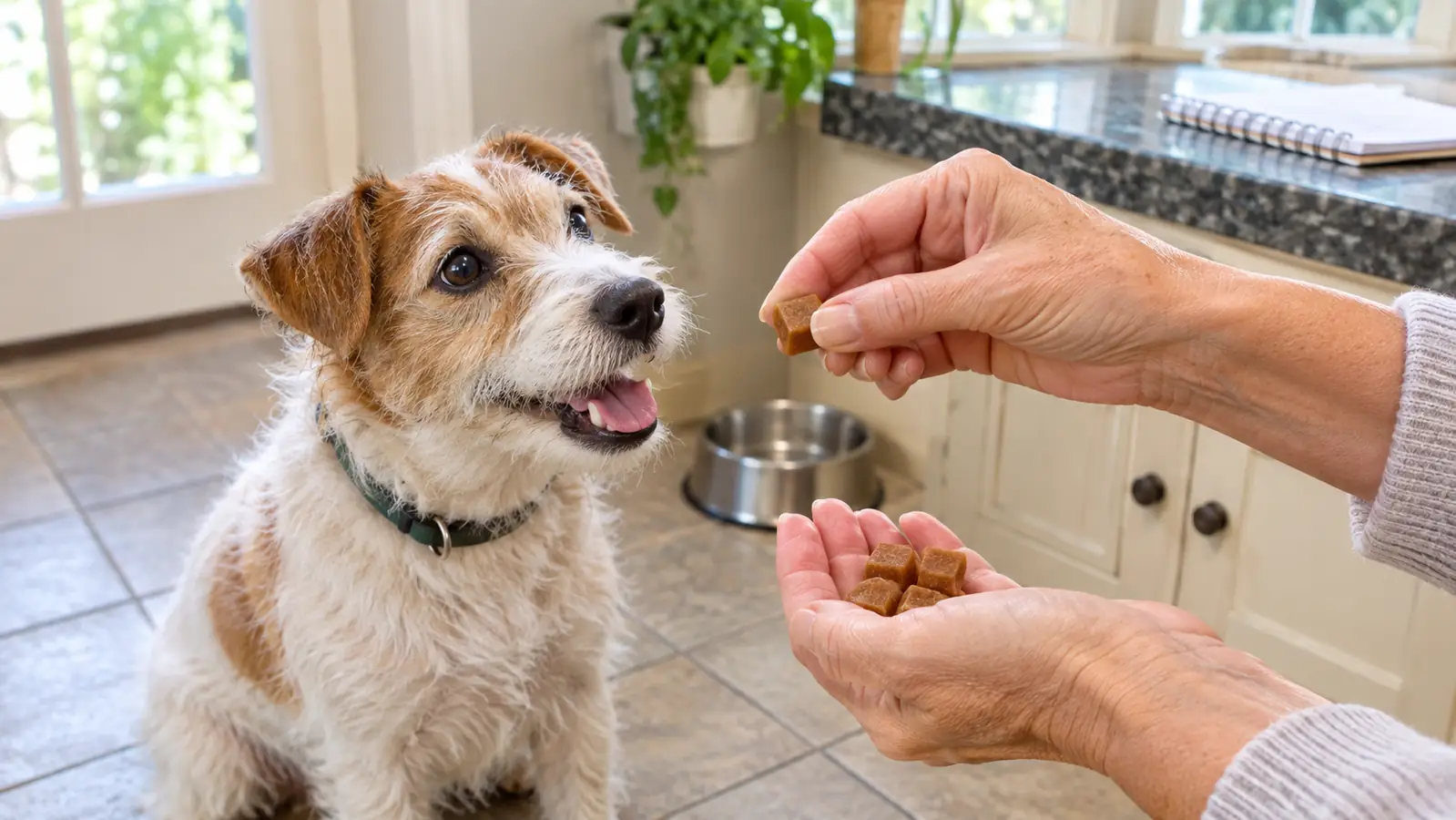
The first morning, I gave Daisy the amount the label's chart gives for her weight, which is one soft chew at twenty-six pounds, and I did nothing else different that day. No new food, no new treat, no new anything. If something goes sideways with a dog's stomach you want exactly one new variable in the picture, and I wanted it to be the chew. She ate it on the first try, which for a dog who has rejected pills in every delivery system known to man was its own small event.
Then I watched and wrote down nothing at all. That sounds like a joke. It is not. The first week I wrote down whether she ate it, that is all. If I had spent that week hunting for a change in her gait I would have found one, because I wanted to find one, and it would have been my wanting rather than her walking.

Step 4: Pick a time you will not forget and stick to it
Daisy gets hers in the morning with her breakfast, the same way Hank gets his Cosequin from my hand at breakfast. Not because morning is magic, but because morning is when I am already standing at the counter with a bowl in my hand and the tub is already in the cabinet. A supplement given three days a week on no particular schedule is a supplement you are mostly not giving.
The tub lives on the same shelf as the spiral notebook and Hank's Cosequin bottle. Not in the pantry behind the rice, not in the laundry room. If I have to hunt for it, it does not get given. That is not a discipline problem, that is a placement problem, and placement is easier to fix.
Then write it down. A tick mark in the notebook is enough. I started doing that for Hank and it was the only way I could tell you honestly how many weeks he had been on something, and it is the only way you can answer your vet when she asks how long your dog has been on it. If you miss a day, mark the miss. The misses are information. The misses are why I know that Hank's six weeks on the liquid glucosamine in the fall of 2025 ran from mid-September to late October, and that he went back on his tablets the day he could chew again.
"She ate it on the first try, which for a dog who has rejected pills in every delivery system known to man was its own small event."
Step 5: Give it weeks, not days, and let the vet weigh in again
This is the step where I have to be careful with my words, because this is where supplement writing goes bad. I will not tell you what you will see. I will tell you what I did, which was nothing, for a long while. I kept the notebook and I kept the routine and I did not stand over Daisy looking for proof.
What I would say from our house is this: over months, Hank seems a little more willing on the three brick steps on cold mornings, and he gets up from a nap a bit easier than he did two winters ago. He is on Cosequin and a fish oil softgel, and he has also lost a few pounds because the vet asked us to, and Walt walks him every evening whether it is cold or not. I cannot hand any one of those the credit. Anyone who tells you they can is selling something. Daisy, for her part, has no problem we were measuring. Her mussel chew is a keep-her-moving step, on the vet's suggestion, and that is all it is.
Set a date to check in with the vet. Ours is whenever we take a dog in for anything else, because it is an easy thing to raise when you are already there. Bring the notebook. Ask whether to keep going, whether the weight has changed enough to change the amount, and whether anything else the dog is taking has shifted. That is a fifteen-minute conversation that beats a year of guessing.
What Else Helps
A chew is one small brick in a wall, and I would be lying to you if I said it was the whole wall. The things that have mattered most around here are unglamorous. Keeping Hank lean, which our vet asked for and which took months and a smaller scoop. Walking him every evening, which is Walt's job and which he does in the cold and the drizzle and the heat. A rug at the bottom of the three brick steps so the landing is not bare tile. A ramp into the back of the truck, because Hank stopped jumping up there and the ramp was easier on his hips than being lifted.
Inside the house, we have tile and laminate, and an older dog on a slick floor is a dog who braces. I put a cheap runner from the kitchen to the back door and it made more difference to how Hank moves through the house than any single thing I have bought for him. That is a twenty minute fix and it costs less than a tub of chews. Do that before you do anything fancy.
And mind the mouth and the stomach. Soft chews suit a dog with a bad tooth, which is exactly why Hank was on a liquid for six weeks in the fall of 2025 after a back tooth came out. If your dog has dental work coming, ask the vet whether a chew is the right form for that stretch, or whether you should wait. Daisy's mussel bites from Zesty Paws are soft and she has good teeth, so for her it is a non-issue, but it would not be for every dog. If you want to see how the mussel chew has held up over a long stretch in our house, I wrote about that separately, and I also set it side by side with a plain glucosamine chew for anyone trying to decide between the two.
One last thing about expectations, because it is the thing I most want to say and the thing least likely to be printed on a tub. Supplements support joints. They do not fix them. Nothing I have given either of these dogs has reversed anything, and I would not trust a page that told me otherwise. What I can tell you is what the label says, what I did, and what I noticed, and I have tried to keep those three in separate boxes on this page the way I kept them separate in the notebook.
If your vet says green lipped mussel is worth a try, this is the tub in our cabinet
Zesty Paws Mussel Mobility Bites, chicken and mussel flavor soft chews, ninety to a tub. Start with the amount the label's chart gives for your dog's weight, write it in a notebook, and give it weeks.
Amazon Check today's price on Amazon →