
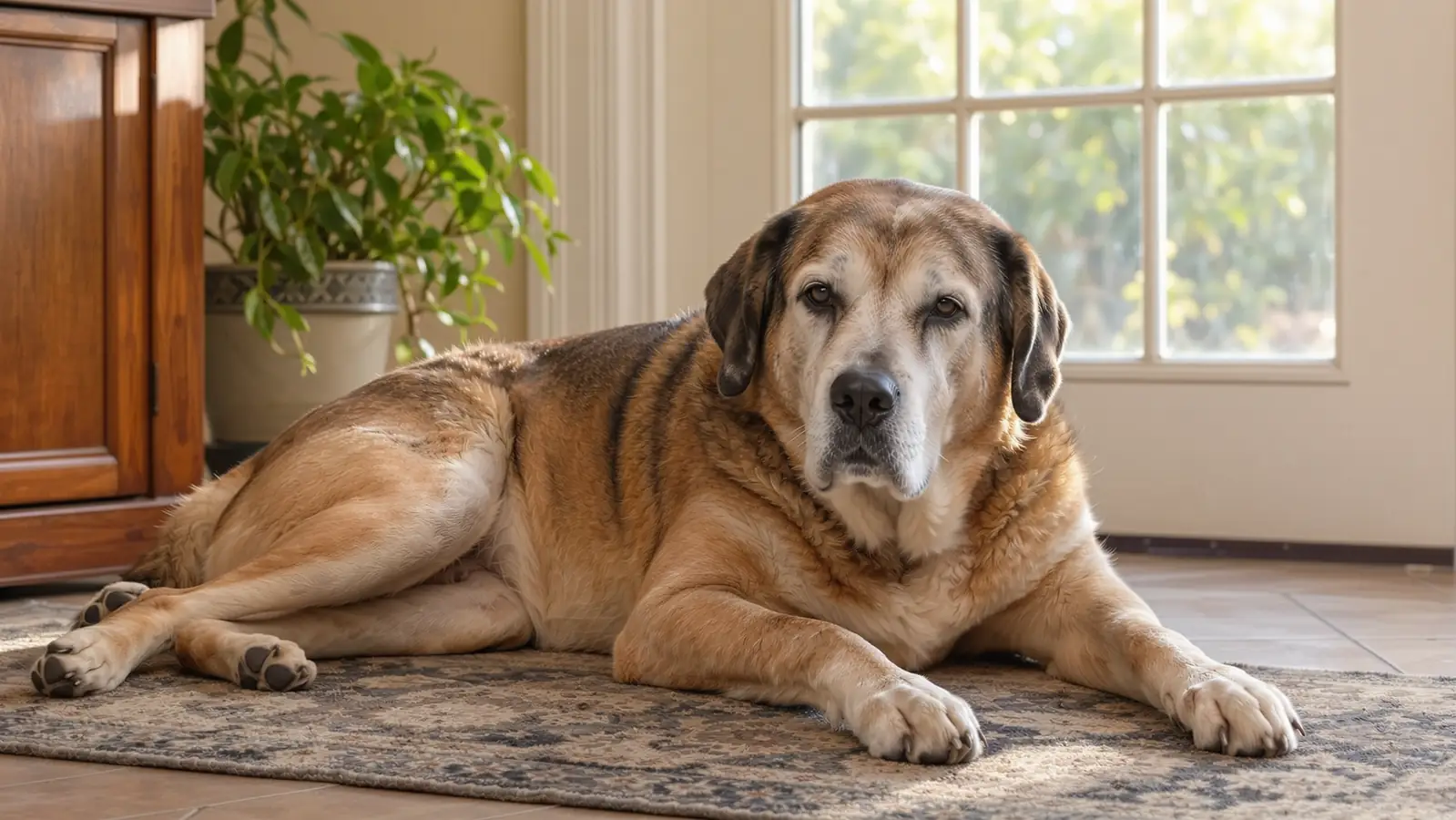
Hank is eleven, about seventy-eight pounds, and he does not pop up off the tile anymore. For a couple of years he has been slow after a nap, stiff on the three brick steps on a cold Tyler morning, and he quit jumping into the back of Walt's truck. Our vet said age-related stiffness in his hips and a little extra weight, suggested keeping him lean, and said we could talk about a joint supplement. That was January 2025. The bottle I reached for is Cosequin from Nutramax Laboratories, the chewable tablets, and this is the routine we settled into. I am not a vet. I am a retired fourth grade teacher who reads labels and keeps a spiral notebook, and I would not start a supplement without your own vet's yes.
Here is the plain version: a supplement is a support, not a repair. Cosequin is labeled for joint health, and the label lists glucosamine hydrochloride, sodium chondroitin sulfate, and MSM. It is a chewable tablet, 132 count, and the amount Hank gets is the amount the label chart gives for his weight. Nothing more. What I noticed over months is modest: he seems a bit more willing on the back steps on cold mornings and gets up from naps a little easier. I cannot credit one thing alone, because Walt walks him every evening and he lost a few pounds at the vet's urging. That is the honest shape of it.
The first step is not the bottle. It is the label and your vet.
If your older dog is stiff and you are staring at a shelf of joint products, start with a vet check and the weight chart on the package. For us, the daily chew is Cosequin from Nutramax Laboratories, a chewable tablet with glucosamine, chondroitin, and MSM.
Amazon Check Cosequin on Amazon →Step 1: Get the vet's yes and write down a baseline
Before I opened a bottle, I called the vet. Hank had been slowing down for a while, and I wanted to know if this was his hips, his weight, his teeth, or just being eleven. Our vet checked him, said age-related stiffness in his hips and a little heavy, and suggested keeping him lean and talking about a joint supplement. That is all. No diagnosis beyond that, and I am not going to make one up.
I wrote the baseline in the spiral notebook taped inside the kitchen cabinet: January 2025, Hank 78 pounds, slow getting up after naps, stiff on the three brick steps on cold mornings, will not jump into Walt's truck. A baseline matters because otherwise you are comparing today to a feeling. Write down what your dog does on a normal day, not the worst day, and not the best day either. I also noted how he slept and whether he seemed sore after the evening walk. The vet asked about all of it, and I would have forgotten half without the notebook.
Ask about medications and other supplements while you are there. Two glucosamine products at once is not a thing I would do on my own. When Hank had a back tooth pulled in September 2025 and the vet said soft food only, I stopped the Cosequin tablets for about six weeks and used a liquid glucosamine over his soft food instead. He never had both at once. That was the vet's instruction and my own rule. The liquid was a stopgap, not a second daily supplement. When the tooth was healed, we went back to the tablets and put the rest of the liquid in the pantry for another chewing problem. That is the only time since January 2025 that Hank has been off Cosequin.
Step 2: Read the label and dose by the weight chart
The Cosequin label gives a chart by weight, and I use the chart for Hank's weight, not a guess and not a scoop from a different product. The label lists glucosamine hydrochloride, sodium chondroitin sulfate, and MSM. The product is a chewable tablet, 132 count. Nutramax Laboratories has been in pet health for over 25 years, and the listing says Cosequin is the number one vet recommended retail joint health supplement brand. That is the listing talking. What matters at my counter is the chart. I read the ingredient list out loud the first time, because Walt wanted to know what was in it. Glucosamine hydrochloride, sodium chondroitin sulfate, and MSM. That was the whole list I cared about. The rest of the label is storage and company information.
If your dog is on the line between sizes, ask the vet which row to use. Hank is about 78 pounds, and I check his weight at the vet before I move him up or down. The chart is not a suggestion to eyeball. It is the only dosing instruction I trust from a bottle. I also read the active ingredients every time I buy a new bottle, because I am the kind of person who reads the same label twice. If I am between bottles, I do not switch to a different brand on a whim. I finish one and start the next, and I write the date on the log. That avoids the question of whether a change came from the supplement or from the switch.
Keep the bottle where you will see it, not where the dog can. Ours lives in the kitchen cabinet next to the spiral log. The tablets are chewable, but Daisy, our beagle mix, would not eat one. She spits out tablets and pills in anything except a soft chew, which is why she was never on this tablet. That is not a knock on Cosequin. It is a fact about Daisy.
Step 3: Make it the same small ritual every morning
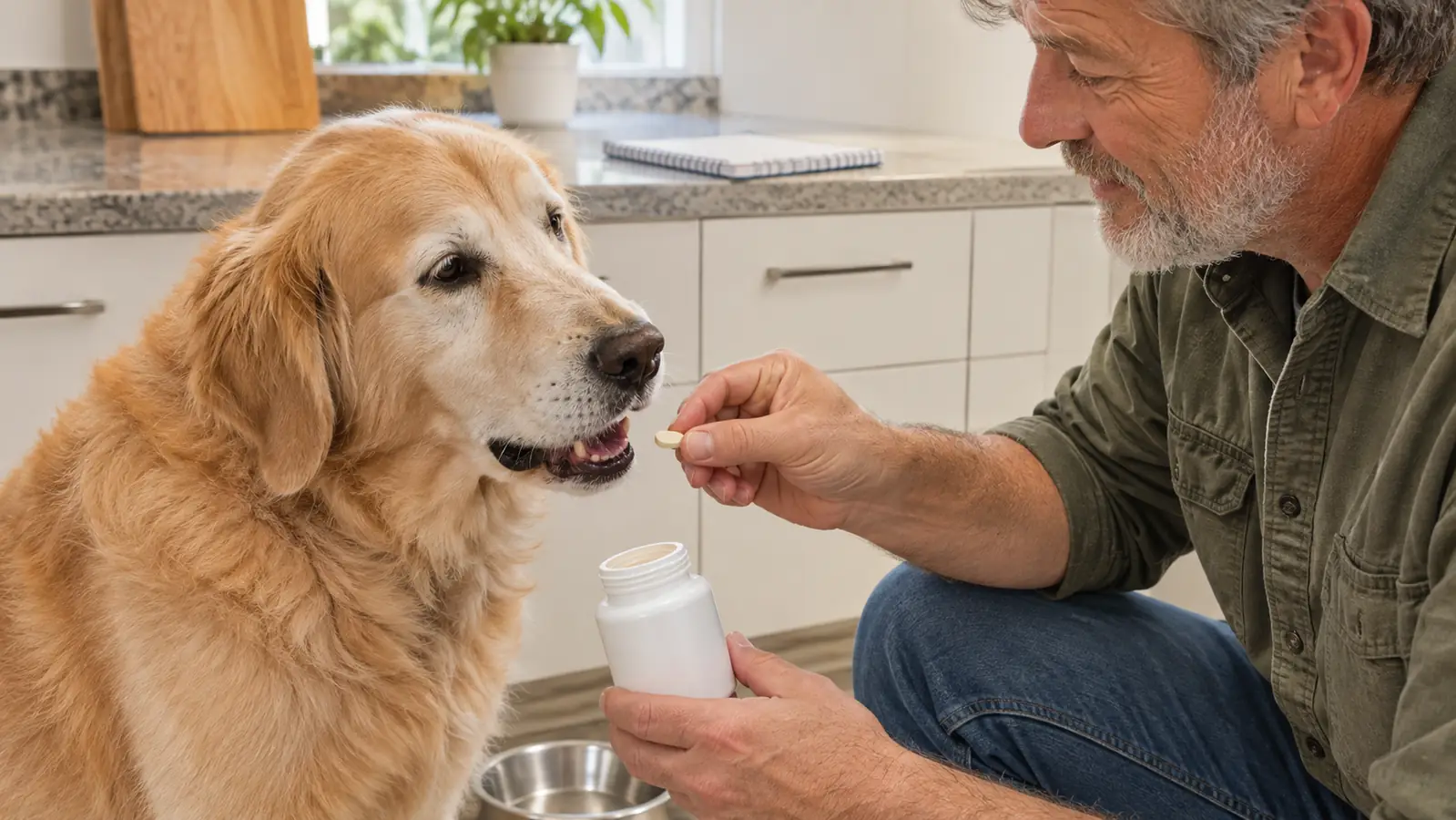
Hank gets his chewable at breakfast, from my hand, before his bowl goes down. Same cabinet, same order, same time. He takes it like a treat. I do not hide it in a wad of peanut butter unless I have to, because I want to know he actually ate it. A dog who eats the pill and a dog who drops it on the floor and walks away are two different situations, and the second one is easy to miss.
The label says chewable tablet. It does not say to crush it or hide it. If your dog is a gulper, watch him for a minute. If he is a spitter, ask your vet about a soft chew form instead of forcing a tablet. Daisy is the spitter in this house, and we learned that with her own supplement, not with Hank's. She needed a soft chew, and that is what she got. Hank has never turned his nose up at the Cosequin tablet. Daisy turned her nose up at every tablet we tried. Two dogs, two different mouths, and that is worth knowing before you buy a 132 count bottle for a picky dog.
The log takes ten seconds. Date, whether he ate it, anything different that day. I started because I taught school for thirty-one years and old habits are hard to break. It also settled an argument with Walt about whether Hank was actually better or we were just having a good week. The notebook is not a medical record. It is a tiebreaker.

Step 4: Give it weeks, and judge the whole dog
I did not see a change in a day. I would be lying if I said I did. What I noticed over months was small: he seemed a little more willing on the back steps on cold mornings, and he got up from a nap with less of that pause. That is all I can say. I never saw him young again, and I would not trust anyone who told me a chew would do that.
This is why the notebook matters. Every couple of weeks I would write one line about the steps, the truck, the evening walk. The vet also had us keep his weight down, and Walt walks him every evening, so I cannot separate the chew from the walks or the lost pounds. I am not going to pretend I can. If you are looking for a straight line from one chew to one result, I do not have it. Some weeks the notebook says about the same. Some weeks it says up easier. I do not treat either one as proof. I treat it as a record.
If your dog gets worse, stops eating, or has a new problem, call the vet. A supplement is not a reason to wait. I keep that in the front of my mind, and I would rather look foolish calling about a small thing than miss a big thing. Cosequin is part of our routine, not a substitute for the vet.
Step 5: Build the rest of the day around the chew
A chew at breakfast is one piece. The rest of the day matters just as much. Hank is leaner than he was, not skinny, just leaner, because the vet said his hips would thank us. Walt walks him every evening, short and slow, on the flat part of the road, not the ditch. We do not do the long trail anymore. He is eleven, and the point is to keep him moving, not to wear him out. On really cold mornings, Walt lets him out the front door instead of the back so he does not have to do the brick steps at all. That is not fancy. It is just one less chance to slip.
Inside, we have tile and laminate, which is slick for an old dog. I put a runner from the back door to the kitchen and a bed in the corner where he can get up without scrambling. The three brick steps are still there. I go down first and let him take them one at a time. That is not medical advice. It is just easier than watching him rush.
Fish oil is the other thing we added, after I asked the vet. Hank gets Nordic Naturals Omega-3 Pet, EPA and DHA, and Walt squeezes it over dinner or gives the softgel in a bite of cheese. The vet said it was fine alongside his glucosamine. I would not add anything else without asking. One glucosamine product at a time is my rule, and I keep it.
What Else Helps
What else helps? The boring things. Keep the weight down. Walk on a surface that is not slick. Give an old dog a bed with enough padding to push up from. Put a rug at the bottom of the steps. Ask the vet before you stack supplements, and bring the bottles with you so you are not guessing at the names. None of that is as easy to buy as a chew, and all of it matters.
If your dog is stiff in the morning, watch him before you decide anything. Is he stiff after a nap and better after a walk? Is he stiff all day? Is he limping on one leg? Is he reluctant to go outside at all? Those are the details your vet needs. The label on a bottle cannot sort that out. Cosequin supports joint health. It does not tell you why your dog is sore.
If you are already giving a glucosamine product, do not add Cosequin on top without asking. The label on Cosequin lists glucosamine hydrochloride, and it is easy to double up without meaning to. Bring every bottle to the vet, including the fish oil and the soft chews, and let them sort out what is what.
And if your dog is lame, yelping, or dragging a leg, that is not a wait and see. Call the vet. A joint supplement is for the slow, stiff, older dog that has been checked. It is not for an acute injury, and it is not a way to avoid a diagnosis. I say that as a person who would rather buy a bottle than make a phone call, so I understand the temptation.
What I noticed was small and mixed in with the walks and the lost pounds. I am not going to sell you a bigger story than that.
Put the chew where you will see it, and put the vet's number where you will see it too.
If you and your vet decide a joint supplement is worth a try, Cosequin from Nutramax Laboratories is the chewable tablet that fit our breakfast routine. Start with the label chart, keep a small log, and give it weeks, not days.
Amazon Check Cosequin on Amazon →