

There are two ways to get fish oil into an older dog, and one of them involves a pump. The Nordic Naturals softgels are what Hank takes, one a day, and have been since March 2025. The salmon oil is what I stood in the aisle at the feed store reading for twenty minutes with my glasses pushed up on my head, because the bottle had a guaranteed analysis on the back and I wanted to see what it actually said.
Hank is our yellow Labrador, eleven years old, about seventy-eight pounds, stiff through the hips on cold mornings and slow to rise from a nap on the tile. Our vet called it age-related and suggested keeping him lean and talking about a joint supplement. When I asked whether fish oil could go alongside his glucosamine, the vet said that was fine. Daisy, our beagle mix, has never had any of it, because Daisy will not take a gel and I am not going to wrestle her over one. I am not a veterinarian. I am a retired fourth grade teacher who reads a label the way she used to grade a paper, which is slowly, and looking for what is not there.
So this is a comparison of two forms, not two promises. Neither one rebuilds a hip. What either can do is put a known amount of EPA and DHA into a dog on a regular schedule, and the schedule is the part that lives or dies on whether you can be bothered at seven in the morning.
How I Ended Up Comparing Fish Oils
It started with a woman at the feed store telling me salmon oil was simpler. She was right that pouring is simpler than counting, and I want to give her that before I spend the rest of this piece disagreeing with her about the rest of it.
There were four bottles of salmon oil on that shelf. Two of them listed crude fat and moisture and stopped, which tells you the bottle contains fat and not water and not much else. One listed omega-3 fatty acids as a single total with no split between EPA and DHA. And one of them was labeled for people rather than for dogs, which is worth saying out loud, because those bottles sit right next to each other and the print is small.
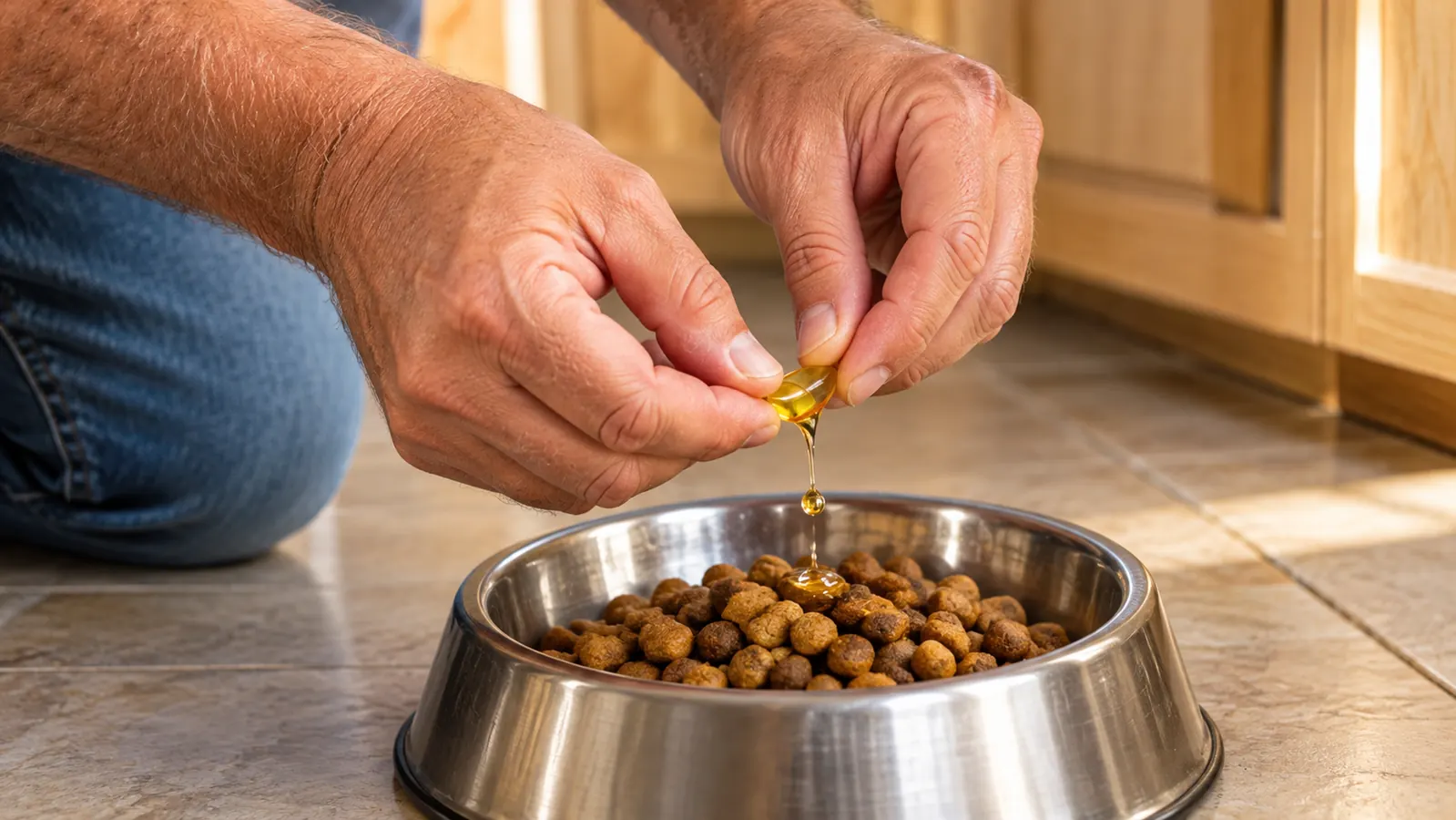
The Nordic Naturals label does the thing I want a label to do. It states the EPA and the DHA, and it states them in the amount that is inside one softgel, not per some serving I have to calculate against my dog's weight first. It says the oil is in the triglyceride form, which the listing describes as the form naturally found in fish. It says no artificial colors, flavors, or preservatives, and no gluten or dairy. Facts I can check are worth more to me than adjectives I cannot.
For Hank, at seventy-eight pounds, the arithmetic is one gel. That is the whole chart as far as my kitchen is concerned.
| Nordic Naturals Omega-3 Pet | Salmon oil | |
|---|---|---|
| Form | Unflavored softgel, swallowed whole or squeezed over food | Liquid oil, poured or pumped |
| Measuring a dose | One softgel is one softgel, and the label chart gives the count for the dog's weight | A pump stroke or a spoon, and the oil separates so it needs shaking first |
| EPA and DHA on the label | Stated per softgel | Varies by bottle, and some list only crude fat |
| Storage after opening | Gels hold their shape in a counted bottle | An open bottle of oil has a clock running on it |
| Getting it past a suspicious dog | No flavor of its own, so it rides on whatever you put it on | The fish smell does half the persuading |
| Small dogs and very big dogs | A fixed gel, so a small dog gets a partial squeeze and a giant dog just gets more gels | A short pump for a small dog, a longer one for a big dog |
| Ingredient list | Fish oil plus the gel, with no artificial colors, flavors, or preservatives, and gluten free and dairy free | Often salmon oil alone, depending on the bottle you pick up |
| Two dogs on two different amounts | Two gels, counted separately | One bottle, two pump counts |
Where Nordic Naturals Wins
It wins on measurement, and I know that sounds like a small thing until you have done it the other way. A pump is not a dose. A pump is a motion. Two people squeezing the same pump get two different amounts, and the bottle tells you to shake it because oil separates, so the pour near the bottom of the bottle is not the pour near the top. A softgel cannot separate. It is the same softgel on the first day and on the ninetieth.
It wins again on the label, for the reason I gave above. When the EPA and the DHA are printed per gel, I can tell you exactly what Hank had for breakfast. With a liquid, I can tell you roughly what he had, after I check the serving size, the number of servings in the bottle, and whether the numbers on the back are per teaspoon or per pump. That is three chances to get it wrong before the dog has even smelled his dinner.
And it wins on the day my husband does dinner instead of me. Walt does not want a chart. He wants to know how many. One. That is the difference between a supplement that gets given in February and one that sits in the cabinet being a good idea. The bottle is 180 softgels, which at one a day is a good long while, and it lives next to my spiral notebook without needing to be shaken, wiped, or moved off the counter edge.
Where Salmon Oil Wins
Salmon oil wins on the dog who will not take a capsule, and I have one of those. Daisy is eight, twenty-six pounds, adopted from the Smith County shelter in 2019, and she can find a pill in a piece of cheese the way a teller finds a counterfeit bill. If she ever needed fish oil, I would not begin with a gel. I would begin with something that smells like a fish, because smell gets past the suspicion that a capsule sets off before the dog has even tasted it.
It wins on the small dog and on the very big one. Part of a softgel is a real thing people do and I have done it, and it is fiddly: you end up with oil on your thumb and the other half of a gel looking at you. A short pump into a bowl is neater. On the other end, a very large dog that needs more oil than one gel holds has no easy way to get it from a bottle of gels except more gels. A liquid just pours.
And it wins on the ingredient list, if you get a bottle that has one. Salmon oil and nothing else is a short list, and there is a plain kind of comfort in that when you are already giving your dog two other things at breakfast.
The bottle Walt can hand out without reading a chart
Nordic Naturals Omega-3 Pet, 180 unflavored softgels with EPA and DHA printed on the label. This is what Hank has taken every single day since March 2025, alongside his glucosamine and with our vet's okay. One gel. That is the whole dose for a seventy-eight pound dog.
Amazon Check Today's Price on Amazon →A pump is not a dose. A pump is a motion, and two people squeezing the same one get two different amounts.

What the Labels Actually Say
Since I told you I read labels like homework, here is the homework. The Nordic Naturals bottle is 180 softgels, unflavored, and the label carries EPA and DHA in the amounts per softgel. It is listed for dogs and cats. It is not made with artificial colors, flavors, or preservatives, and it is gluten free and dairy free. Nothing on that bottle is a promise about arthritis. It is a statement about what is inside the gel.
A salmon oil bottle is a different kind of document. The guaranteed analysis on the ones I picked up listed crude fat at a minimum and moisture at a maximum, and one of them listed omega-3 fatty acids as a single number. Crude fat tells you it is fat. It does not tell you how much EPA and DHA is in a teaspoon, and if the bottle does not print that, you are guessing at the very part you came for. If it does print it, read the serving size it is printed against, because per teaspoon and per pump are not the same number.
One more thing that does not show up on either label until you think about it: oil is calories, and calories matter to a dog who has been told to lose a few pounds. Hank was a little heavy at his last check, and our vet wanted him lean for his hips. Adding a daily pour of oil to his dinner while he is supposed to be slimming down is a conversation to have with your vet, not a decision to make in a feed store aisle. That conversation is part of why we landed where we landed.
And if you are switching from one form to the other, do it the dull way. Write down what you were giving and what you are giving now, keep the old bottle until the new routine has held for a couple of weeks, and mention the change at your next vet visit rather than deciding it was fine on your own. I say that as a person who once changed a dog's food abruptly and spent a long night learning better.
What I Liked
- EPA and DHA printed per softgel, so the dose is on the label and not in my head
- Unflavored, so it goes over dinner or inside a bite of cheese without a fight
- No artificial colors, flavors, or preservatives, and gluten free and dairy free
- A counted bottle that Walt can hand out without reading anything first
- Hank has taken it daily since March 2025 and still takes it without coaxing
Where It Falls Short
- One gel is one gel, so a small dog ends up with a partial squeeze
- It has no flavor of its own, which does nothing for a dog who is off his food
- A dog who spits pills, like Daisy, cannot take it at all
- It does not stretch: a dog needing more oil needs more gels
What We Noticed In Our House
I kept the log in the spiral notebook taped inside the cabinet door, date and dose, for the first month, and then I got honest with myself and stopped, which I suspect is what happens to most logs. What I can tell you is that the gel went into him every day, which is more than the feed store glucosamine tablet ever managed, because that one had to be crushed into wet food and he would still turn his head away.
Over the months, with the Cosequin and the fish oil together, Hank seems a little more willing on the three brick steps on a cold morning and gets up from his naps a bit easier. He also lost a few pounds because the vet asked us to, and Walt walks him every evening whether it is ninety degrees or not. I cannot pull the capsule apart from the walking and I am not going to try. Nothing about that is a claim. It is what I see from the kitchen window.
Daisy is the other half of the picture and she is the reason I am careful about this subject. She has a supplement of her own, a soft chew she takes like a treat, and she has never had a drop of fish oil, not because I think it would hurt her but because I could not get it into her without a fight and a supplement that starts a fight stops getting given by the second week.
Who Should Buy Which
Take the Nordic Naturals softgels if your dog already takes something in a piece of cheese or over dinner, if you want the EPA and DHA stated per dose so you are not doing arithmetic at the bowl, if you travel and want a bottle that does not need shaking, or if someone else in the house gives the supplements and you would rather they did not have to remember a pump count. That is our house, and that is why the bottle in the cabinet next to the notebook is the Nordic Naturals one.
Take the salmon oil if your dog will not take a capsule, if you have a very small dog or a very large one where a gel is the wrong size in either direction, or if you want a single ingredient and a short list. And if you take that road, pick a bottle that prints EPA and DHA and says per what, and take it to your vet along with the rest of your dog's medications before you start. A supplement is not a fix. It supports a joint. It does not repair one, and no label on either shelf says otherwise.
If your dog is on other medication, or has a condition your vet is already treating, then neither bottle is a decision you make by yourself in an aisle. Take the labels in. I did, and it changed what we bought and how much of it, and it is the cheapest part of this whole business.
One gel, one number, every morning
180 unflavored softgels with EPA and DHA on the label, listed for dogs and cats. Ask your vet first, the way I did, especially if your dog is on anything else.
Amazon Check Today's Price on Amazon →