

Daisy is my eight year old beagle mix, twenty six pounds, adopted from the Smith County shelter in 2019, and she is the reason I keep a spiral notebook full of dog notes taped inside my kitchen cabinet. She is also the pickiest animal I have ever fed. She will take a pill from your hand, hold it in her cheek like a chipmunk, walk three steps away, and spit it onto the tile without breaking eye contact. Cheese does not work. Peanut butter does not work. A piece of leftover brisket does not work. She finds the pill, and she always finds the pill.
That is the whole problem with joint supplements and a beagle. The tablets that work fine for my yellow Lab, Hank, are a nonstarter with her. So when our vet suggested a joint supplement for Daisy as a keep her moving step, I went looking for something soft. What we landed on was VETIQ Maximum Strength Hip and Joint soft chews, chicken flavor, and she ate the first one on the kitchen floor in about four seconds. That is the short version. The long version is the five steps below, because getting a picky dog to take a chew once and getting her to take it every morning for months on end are two different jobs.
The soft chew that got past the beagle's nose
VETIQ Maximum Strength Hip and Joint soft chews are the chicken flavored soft chew Daisy took on the first try. Read the label, call your vet about the dose, then look at today's price on Amazon.
Amazon Check Today's Price on Amazon →One honest note before the steps. This is what worked in our house with one picky dog, and it is not veterinary advice. I am not a vet and I never played one in a classroom. If your dog is on medication, has a diagnosed condition, or is already taking a joint product, the phone call to your own vet comes before anything in this article.
Step 1: Read the label, then call your vet
I taught fourth grade for thirty one years, so I read a label the way I used to grade a paper. First I want the list of what is actually in it, then I want the dosing chart by weight, then I want to know how many chews are in the tub. The VETIQ label lists glucosamine HCl 600 mg, fish oil 280 mg, and krill 210 mg, along with MSM, and the tub holds 180 soft chews. Those numbers are why I was willing to try it. They are also why I called the vet before I opened it.
That call matters more than every trick in this article. Daisy is not on any other medication, so our conversation was short, but a dog who is on medication, or a dog with a diagnosed condition, needs her own vet to look at the label and the dose. Your vet knows the bloodwork, the weight history, and the thing your dog did last Tuesday that you forgot to mention. None of that is in a blog post, including this one.
The dosing chart goes by weight. Daisy is twenty six pounds, so she gets the amount the chart gives for her weight. Not half a chew because she is small. Not two because she had a good day. I wrote the number on an index card and taped it inside the cabinet door so Walt and I would give her the same amount without arguing about it at seven in the morning.
What sold me was the form. Daisy does not chew tablets, she holds them. A soft chew is a different job for her mouth, and chicken flavor means she is not being asked to ignore a smell she dislikes. That is also why I did not start with a capsule I could open and pour over her food. The pour works for some dogs. It has never worked for this one.
Step 2: Pick one time and one place, and do not move them
Dogs are routine animals, and picky dogs are routine animals with opinions. In our house the joint chew happens in the kitchen, right after the morning walk, before the food bowl comes out. Same tile, same time, same order. Daisy learned that sequence in about a week. By the second week she was standing in the kitchen waiting for it before I had my shoes off.
What I would not do is hand it over at random. Once at noon, once at bedtime, in the living room one day and the back yard the next. That turns the chew into a novelty, and a novelty is something a beagle inspects. A routine is something a beagle expects.
I also would not put it in the food bowl, at least not in the first month. Daisy sorts her kibble. If the chew is in the bowl she pushes it to the rim with her nose and looks at me like I have insulted the entire household. Hand to mouth, kitchen floor, done.
The order matters more than the clock. Walk first, because a dog who has just been outside is relaxed and already in a good mood. Chew second. Breakfast third. If I flipped it and offered the chew after she ate, she would look at me like I had brought her a second dessert she did not order.
Step 3: Offer it flat on your palm, then get out of the way
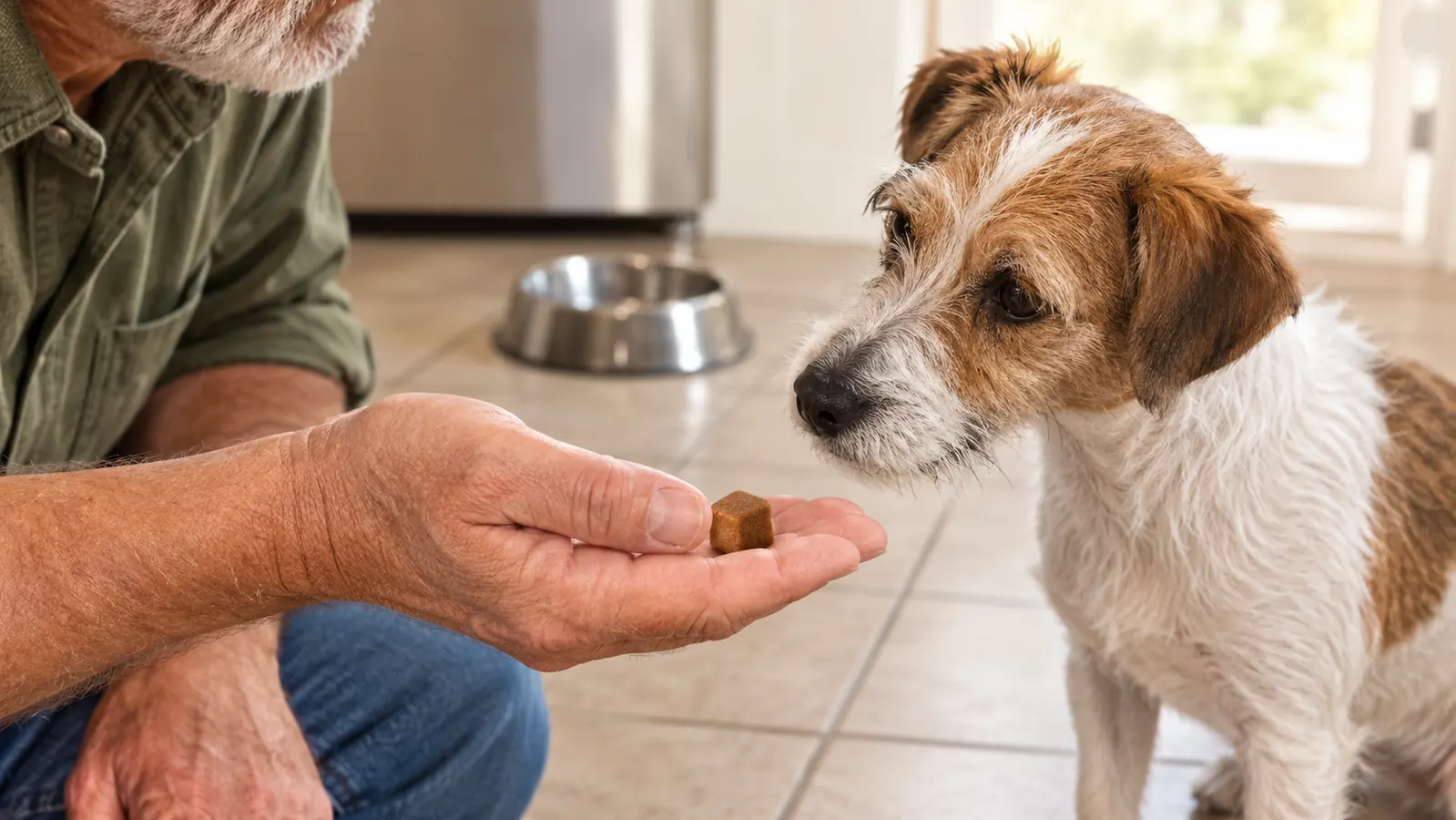
The first one, I sat on the floor and held it out on my flat palm. I did not wave it around. I did not say anything in a high voice. I did not stand over her. She sniffed it twice, took it, and carried it to the rug to eat. That was the whole event.
If she had refused it, my plan was to put it back in the tub and try again the next morning. Not to chase her around the kitchen with it, and not to break it into pieces and follow her. A dog who is chased learns that the chew is a thing to be avoided. A dog who is left alone with it gets to be curious on her own schedule.
Here is the mistake I made with a tablet years ago and would make again if I were not paying attention. Do not crush the chew into her dinner on day one to get it down her. If it does not work, you have taught her that her dinner tastes strange, and now you have a second problem on top of the first one. Keep the chew separate from the meal until you know she will take it.
Daisy will spit out a tablet, a capsule, or a pill wrapped in cheese. She ate the VETIQ soft chew on the first try, and that is the entire reason it stayed in our house.

Step 4: Write it down every single day
The spiral notebook is taped inside the cabinet door next to the tub. Every morning gets a date and a check mark, and if she leaves it, that gets a note. It sounds fussy for a dog chew. It is also the only reason I can tell you that she took it every day from April of 2025 through December of 2025, two tubs, without a gap.
A supplement is not a light switch. You are not going to see anything on day three, and if you are watching that hard you will probably imagine something and then credit the wrong thing. The notebook keeps you honest. It also gives your vet real information at the next checkup instead of a vague feeling that she seems better lately.
What I wrote down was not a score. With Daisy there was never a problem to measure, this was a keep her moving step from the start, so the notebook was mostly a record of her taking it and of small things worth mentioning to the vet. Hank is the one with the stiff mornings, and even for him the notes are observations, not grades.
Step 5: Have a plan for the day the novelty wears off
It might not wear off. Daisy took hers every morning from April through December and never once refused it, which is a record in this house. But picky dogs change their minds the way the weather does, and it helps to have a next move that is not a new product.
My next moves, in order. Hand it to her before the walk instead of after. Set it on the floor instead of in my palm. Break it into two pieces and give them a minute apart. Hold it in your hand for a few seconds first so it smells a little stronger. If none of that works, skip a day and start again. Do not turn breakfast into a standoff you cannot win.
What I would not do is switch brands every two weeks looking for one she will never refuse. The chew is not the point. The point is the label going into her every day, and a dog who is constantly being switched is a dog who is constantly being watched, which makes a picky dog more suspicious, not less. If she refuses for several days in a row, that is a call to the vet, not a reason to buy a third tub of something else.
One last practical thing. The chews live in the cabinet, not on the counter next to the stove. The index card with the dose stays beside the tub. When a tub is empty I write the date on the lid before it goes out, because that is how I know how long one actually lasts us, and it keeps me from guessing at the next vet visit.
What Else Helps
The chew is one piece of a bigger picture, and I would be lying if I said it was the whole thing. Weight matters more than any tub in my cabinet. Our vet told me to keep Hank lean, and I have heard the same thing about Daisy. A lighter dog puts less load on her joints with every step she takes, and that part is free.
Walks matter too, and I mean steady ones, not long marches. Daisy gets a sniffing walk every evening with Walt, and I think the sniffing is half the benefit. So does the recheck at the vet, because you want a professional to tell you whether the thing you are doing is worth continuing, instead of guessing from your kitchen floor.
The other thing that helps is not doubling up. Hank has his own glucosamine product and Daisy has hers, and I never give two glucosamine products to the same dog at the same time. When Hank had a back tooth pulled in the fall of 2025 and the vet said soft food only, I stopped his tablets and used a liquid glucosamine over his food for about six weeks, then went back. One dog, one glucosamine product, always.
Daisy is on a different chew now, a green lipped mussel chew the vet suggested in January of 2026, and she eats it just as eagerly. That is not a knock on the VETIQ chews. It was a vet suggestion and I do what the vet says. If your dog is a senior with diagnosed arthritis, a supplement is a conversation with your vet, not a substitute for one, and it is not a substitute for pain management either.
And what I will not tell you is that a supplement fixed anything. It supports joints. It does not cure, treat, or reverse arthritis, and no chew on Amazon will. In our house it is a small daily piece of a larger routine, alongside the walks and the weight and the vet, and that is as far as I will go.
Start with the label, then start with one chew
VETIQ Maximum Strength Hip and Joint soft chews, chicken flavor, 180 count. Ask your vet about the dose for your dog's weight, then see today's price on Amazon.
Amazon Check Today's Price on Amazon →