

I will start with the part most reviews of this bottle leave out. Nordic Naturals Omega-3 Pet softgels did not fix my dog's hips. Hank is an eleven year old yellow Labrador, about seventy eight pounds, and our vet has told us he has some age related stiffness in his hips and that he is carrying a little extra weight. A fish oil softgel was never going to change that on its own. What it did do was give me one more small thing to put in his bowl at dinner, every single day, that his vet said was fine alongside his glucosamine. Twenty months later I still buy it. Here is everything I wish somebody had told me first.
Second thing before we get into it. I am not a veterinarian. I taught fourth grade for thirty one years, and I read a label the way I used to grade a stack of papers, which is to say slowly, and with a red pen in my hand. If your dog is on medication, or has a diagnosis, or is getting up stiff in the mornings, the first call is your own vet's office and not a review on the internet. What follows is what happened in our house, with our two dogs, on our tile floor outside Tyler, Texas.
The Quick Verdict
An unflavored EPA and DHA softgel that a stiff old Labrador will actually take every evening. It is not a joint supplement and it is not a pain pill, and it will not show you anything for months. It is also the one fish oil I have never stopped buying.
Amazon Check Today's Price →The bottle in our refrigerator door that Hank has never once refused
Unflavored EPA and DHA softgels, 180 to the bottle, squeezed over dinner or swallowed whole in a bite of cheese. Same bottle, every evening, since March 2025.
Amazon Check Today's Price on Amazon →What Nobody Tells You About Fish Oil for Dogs
The first thing nobody tells you is that fish oil is not glucosamine. The two get shelved together and talked about in the same breath, and owners walk away thinking they are versions of the same product. They are not. Glucosamine and chondroitin are what Hank gets in his chewable tablet. EPA and DHA are what is in this softgel. When I asked our vet whether the two could go together, she said the fish oil was fine alongside what he already takes. That is the whole of what she said, and it is the whole of what I will claim here.
The second thing is that a bottle of pet fish oil is a commitment to a routine, not a purchase. The dosing chart on the label goes by weight, which means somebody in the house has to be the person who measures and remembers. In our house that person is me, and the reminder is a spiral notebook taped inside the kitchen cabinet door where I write down what Hank gets and when he gets it. If you are not going to keep a log or keep a routine, your money is better spent somewhere else. This is not a product that does anything sitting in the pantry.
The first week I copied the weight column off the label's chart into the front of that notebook in pencil, so I would not have to squint at the bottle every evening with my reading glasses still out on the counter. That page is still there, under a year and a half of entries, and it is the only reason I can tell you what we did in any given month. It took ten minutes and I have used it two hundred times. If you take one thing from this review, take the pencil.
The third thing nobody tells you is how unglamorous the whole business is. There is no visible change in a week. There is no visible change in a month. Somewhere around the third or fourth month I realized I had stopped bracing myself every time Hank got up off the kitchen floor, and that is the closest thing to a moment of revelation this bottle offers. Even that I cannot hand to a softgel by itself, because Walt walks him every evening and he has dropped a few pounds because the vet asked us to keep him lean.
What Is Actually in the Bottle
Here is what the label and the listing say, because that part I can vouch for. Nordic Naturals Omega-3 Pet is a fish oil softgel, 180 to the bottle, unflavored, with eicosapentaenoic acid and docosahexaenoic acid listed as the active ingredients. The listing describes the oil as being in the triglyceride molecular form, which it notes is the form naturally found in fish. It also says the ingredients are non GMO and gluten free and dairy free, with no artificial colors, flavors or preservatives. The bottle weighs 11.04 ounces and measures 6 by 5 by 4 inches. The softgels are listed at 0.64 ml. The target species on the listing is dog and cat, which matters if you keep both. We do not.
I read that list the way I used to read book reports, looking for what is missing as much as for what is there. What is not there is a long column of extras. No flavoring. No sweetener. Nothing to make it taste like chicken. That is the trade you are making when you buy this particular bottle, and it is worth knowing before it arrives.
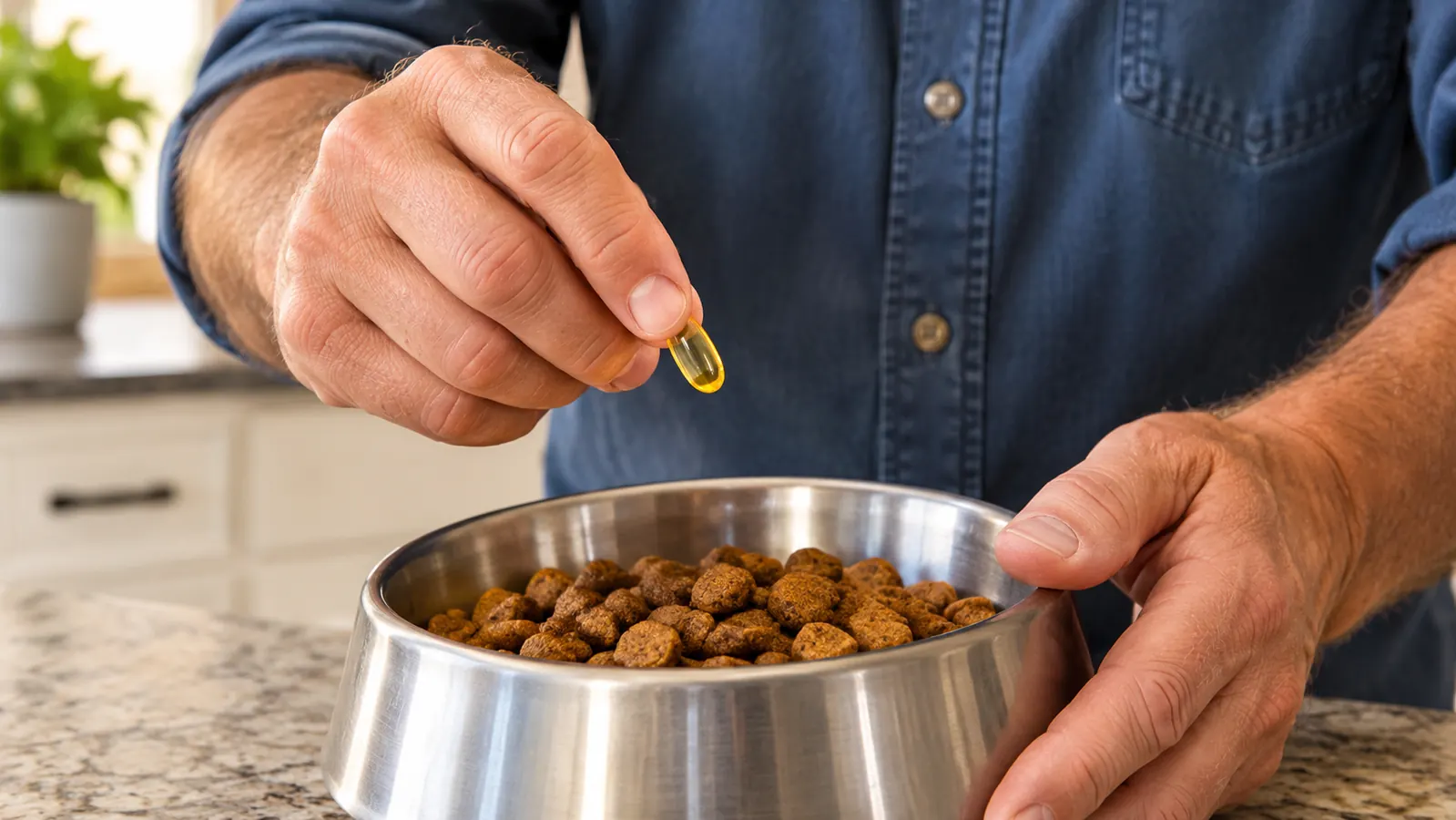
The unflavored part cuts both ways and I want to be straight with you about that. It means you can squeeze a softgel over dinner without changing how dinner tastes, which is what Walt does most nights. It also means there is nothing inside the softgel persuading a dog to take it. Hank gets his either squeezed over his kibble or swallowed whole inside a bite of cheese, and he has never turned down the cheese. If your dog is a pill spitter, this is a real obstacle and not a small one.
What I Liked
- EPA and DHA are the active ingredients and they are listed plainly on the bottle
- Unflavored, so it goes into a normal dinner without changing the taste of it
- Hank has taken it every evening since March 2025 with no refusals
- Our vet said it was fine to use alongside his glucosamine tablet
- No artificial colors, flavors or preservatives, per the listing
Where It Falls Short
- Not a joint supplement and not a pain pill. It does not replace glucosamine
- The softgel has to be squeezed or hidden, and Daisy would not touch it
- One more step in the evening, every evening, and the bottle empties faster than 180 sounds
- You will not see anything for weeks, so it is a poor fit if you want fast feedback
How I've Used It
We started in March 2025, a couple of months after Hank began his glucosamine tablet. I asked the vet about fish oil at his next visit because I had been reading about EPA and DHA and I wanted a straight answer from somebody with a degree rather than from a comment section. She said it was fine alongside what he was already taking. So I bought the 180 count that week and we began. The routine settled fast. Walt keeps the bottle in the refrigerator door next to the cheese, pokes one softgel with a paring knife and squeezes it over Hank's dinner, or if he is in a hurry, Hank takes the whole thing inside a bite of cheese. Every evening. That is the entire procedure.
The first attempt was not elegant and I want that on the record. I set a whole softgel on top of his kibble the way I had read to do it, and Hank ate the kibble around it, then looked up at me as though I had insulted him. It sat in the bowl until it went warm and soft and worse than it started. Walt tried the paring knife the next night on a Nordic Naturals softgel, squeezed it over the top, and that was the end of the argument. The cheese came later, for evenings when one of us was running late.
The one stretch where I had to think about it was the fall of 2025, when Hank had a back tooth pulled and the vet said soft food only for a few weeks. For about six weeks I stopped his chewable glucosamine and poured a liquid glucosamine over his soft food instead, so he was never on two of those at the same time. The fish oil did not change during that stretch. It is not a glucosamine product, so there was nothing to juggle. Hank licked his bowl clean the entire time and went back on his chewable tablet in late October.
Daisy, our beagle mix, does not take this. She is eight, she is twenty six pounds, and she will spit out anything that is not a soft chew. I could probably get a squeezed softgel into her over canned food, but she already takes a green lipped mussel chew at our vet's suggestion and I decided not to add another thing to a small dog's bowl. That is a decision about our house and not a verdict on the product. Plenty of smaller dogs take fish oil. Mine simply has other plans.
The label says what it says. What I can tell you is that somewhere around the fourth month I stopped bracing myself every time Hank got up off the kitchen floor.
What I Noticed, and What I Did Not
I am going to be as careful here as I know how to be, because this is where reviews tend to go wrong. I did not notice a difference in a week. I did not notice one in a month. What I can say is that by that summer Hank seemed a little more willing on the three brick steps at the back door on cold mornings, and he was getting up from his naps a shade easier than he had the winter before. He is also walked every evening by Walt, and he lost a few pounds at the vet's urging, and he had been on a glucosamine tablet the whole time. I cannot separate the fish oil from any of that. I am not going to pretend that I can.
There was a morning in February when the thermometer by the back door read just above freezing and Hank came down the three brick steps without the half second of gathering himself that had become his habit the winter before. I wrote it in the notebook that night, and then I wrote underneath it that Walt had walked him the evening before and that he was a few pounds lighter than he had been the year prior, because I did not want to fool myself later when I read the page back. That is the honest size of the thing.
What I did not notice matters just as much. His hips did not stop being stiff. He still does not jump into the back of Walt's truck, and we lift him now or he stays home. He still has slower days, especially when the weather turns. If you are looking for a product that changes the diagnosis, fish oil is not that product. If you want a reasonable thing to add alongside what your vet has already approved, this is a fair one.
The other thing I did not expect is how much the notebook would matter. In the spiral log I write the date and whether he took everything, and looking back at a year of entries is a strange sort of comfort. It is evidence that we did the boring things, consistently, for a dog who has been with us since he was a pup.

The Parts I Do Not Love
First, the softgels are not small, and squeezing one takes two hands and a knife. When I do it I get fish oil on my fingers and then I smell like a fish market until I wash up. Walt has gotten good at it. I have not. Second, a bottle of 180 empties faster than the number suggests, because the amount the dosing chart gives for a seventy eight pound dog means it does not stretch the way you would guess when you order it.
There is also the small matter of the counter. A squeezed softgel leaves a slick spot on the tile and a smell that one dry paper towel does not fully lift, so there is a rag folded by the sink now that did not used to live there. The bottle takes a shelf in the refrigerator door that used to hold a jar of pickles, and Walt mentions the pickles about once a month. These are not reasons to avoid a good product. They are the reasons a review like this one gets written.
Third, and this is the one I would want a stranger to tell me plainly: this is not a substitute for anything. Not for the glucosamine, not for the vet visit, not for keeping the dog lean, not for the evening walk, not for lifting him into the truck instead of letting him try. It is one line item on a short list of things that help a little. Anybody telling you a softgel replaces the rest of that list is selling something, not helping you.
Fourth, there is the smell question. Unflavored does not mean odorless. The bottle smells like exactly what it is. It lives in the refrigerator door for that reason, and if you are squeamish about fish you will notice every single time you open it. I have made my peace with it. Walt has not entirely.
Who This Is For
This is for the owner who has already had the conversation with their vet and wants a fish oil with EPA and DHA that is plainly labeled and easy to fold into a routine. It suits a big dog with a good appetite who will take a softgel squeezed over dinner, and it suits a person willing to keep at it for months without expecting a visible payoff. Nordic Naturals Omega-3 Pet is the version we use, and it is the version I would hand to a friend who asked me what to try.
It also suits a household that already has a joint supplement going and wants to add something the vet has cleared alongside it, which is precisely where we stood in March 2025. I am not going to tell you it works for every dog. I have two dogs and only one of them takes it. That should tell you something about how carefully I mean all of this.
Who Should Skip It
Skip it if your dog spits out pills and turns up their nose at anything that is not a soft chew. Daisy is that dog, and this bottle would sit in your refrigerator while you got more and more frustrated. Skip it if you want something that behaves like a pain reliever, because it does not, and the label does not claim that it does. Skip it if you are not going to be consistent, because a fish oil given three days out of seven is a fish oil you are mostly wasting.
And skip it if your dog is on medication and you have not asked your vet yet. I mean that plainly and without any hedging. Hank takes nothing but his supplements and I still made the phone call first, both before the glucosamine and again before the fish oil. A supplement is not a neutral thing just because you can buy it without a prescription.
One bottle in the refrigerator door, one softgel at dinner, one log on the cabinet door
If your vet has already cleared fish oil, this is the bottle Hank has taken every evening since March 2025. Unflavored EPA and DHA softgels, 180 to the count, and a dog who has never once refused one inside a bite of cheese.
Amazon Check Today's Price on Amazon →